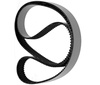
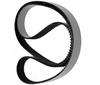
Synchronous and timing belts—also referred to as toothed or cog belts—operate based on positive engagement between the belt teeth and the matching grooves of the pulley. This direct meshing mechanism eliminates slippage and ensures precise synchronization between driven components. Unlike conventional flat or V-belts that rely on friction, synchronous belts maintain consistent speed and timing, making them highly reliable for applications requiring accuracy and repeatability.
This positive drive design enables efficient power and motion transfer across a wide range of applications, including automotive systems, industrial machinery, automation equipment, and precision-driven appliances.
Round-Tooth and Square-Tooth Timing Belts
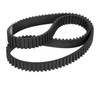
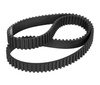
While both round-tooth and square-tooth timing belts serve the same core function, their design characteristics make them suitable for different operating conditions. Round-tooth timing belts feature smoothly contoured teeth that engage quietly with pulley grooves, reducing noise and vibration. They are commonly used in high-speed applications where smooth operation and efficiency are essential.
Square-tooth timing belts, by contrast, have a more robust tooth profile that increases contact area and improves load distribution. This design enhances grip and alignment, making square-tooth belts ideal for heavy-duty applications that require higher torque transmission and increased resistance to tooth jumping.
Dual Timing Belts
Dual timing belts are designed to manage multiple synchronized drives within a single system. Commonly used in high-performance engines and complex mechanical assemblies, these belts provide enhanced synchronization, improved power transmission, and extended service life through balanced load distribution. Their design makes them well suited for applications where precision and reliability are critical.
Application-Specific Timing Belts
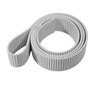
Application-specific timing belts are engineered to meet the demands of particular machines or operating environments. Available in various materials, sizes, and tooth profiles, these belts are optimized for performance in industries such as automotive manufacturing, textiles, printing, food processing, and automation. Customizing belt specifications helps maximize efficiency, reduce maintenance requirements, and minimize downtime.
At BBMPS, we supply a wide range of synchronous and timing belt solutions designed to meet diverse technical requirements and industrial applications. Our team can support you in selecting the right belt configuration to ensure optimal performance, efficiency, and long-term reliability. Request a quote today to find the timing belt solution best suited to your application.